
Why aren't universities more aggressively diversifying revenue to reduce their dependence on student tuition?

Universities operate like businesses. They teach business degrees. So why aren't they rethinking their business models?
Higher education is facing increasing financial pressure. Enrollment challenges, rising operational costs, program closures, and growing concerns about the return on investment of a college degree are forcing institutions to make difficult decisions.
Yet, when programs struggle financially, the solutions often seem to revolve around increasing enrollment, raising tuition, cutting expenses, or closing programs.
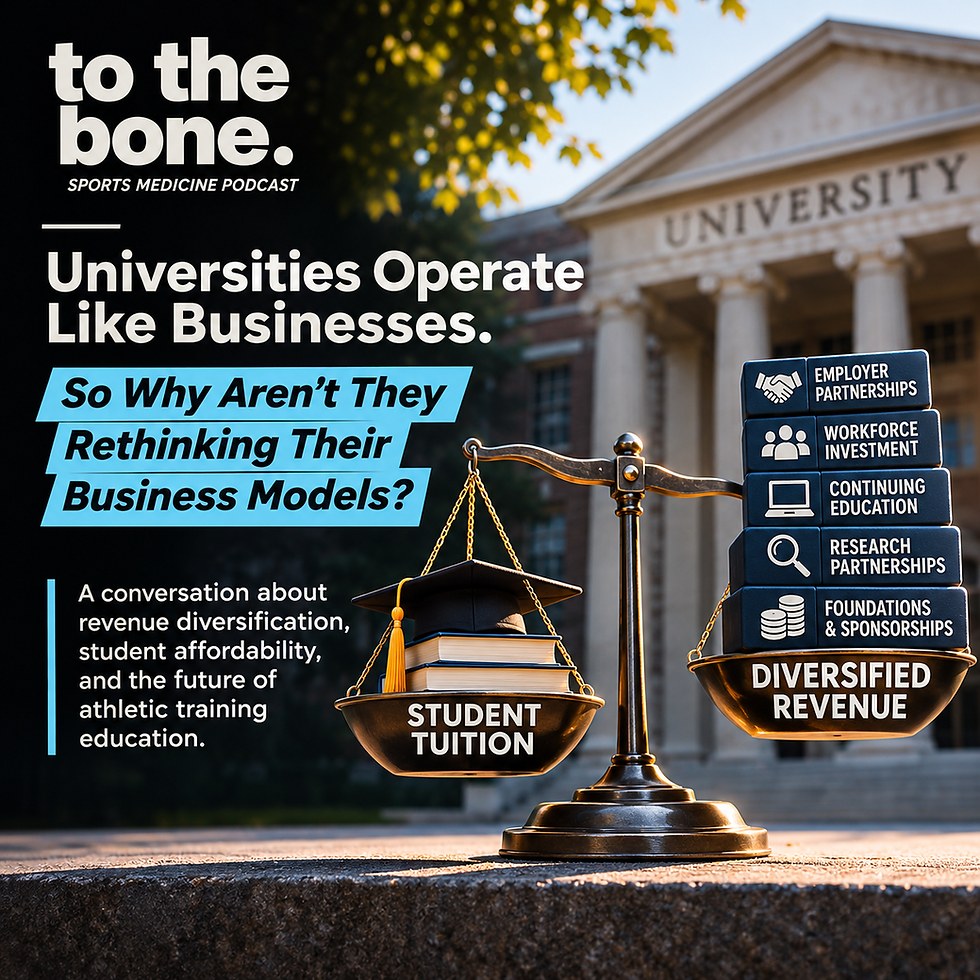
Why aren't universities more aggressively diversifying revenue to reduce their dependence on student tuition?
Universities have presidents, CFOs, marketing departments, advancement offices, development teams, and corporate relations professionals. They have the infrastructure to build partnerships, attract investors, and develop alternative revenue streams.
So why does so much of the financial responsibility continue to fall on students?
Take athletic training education as an example.
Employers report difficulty recruiting athletic trainers. Universities struggle to fill cohorts. Prospective students question whether the cost of graduate education is justified by their anticipated salaries.
Three stakeholders. Three interconnected problems. Yet relatively few coordinated financial solutions.
What if universities approached employers not just as places to send graduates, but as investors in developing their future workforce?
What if hospital systems, orthopedic practices, school districts, industrial employers, professional sports organizations, and foundations contributed to tuition assistance through structured partnerships?
What if universities developed additional revenue through continuing education, corporate training, research partnerships, and professional development programs, with a portion reinvested into student affordability?
Not every student's tuition needs to be completely covered. But reducing the financial burden by even 20–30% could meaningfully change the recruitment conversation.
And this responsibility shouldn't fall exclusively on academic program directors. This is an institutional business development issue that requires leadership beyond the academic department.
If universities are going to operate with corporate-style structures, shouldn't they also be expected to demonstrate corporate-level innovation in revenue diversification?
Rather than continually asking students to absorb the increasing cost of education, perhaps institutions should be asking:
How can we generate more value from the stakeholders who benefit from our graduates, while asking students to finance less of it?
The conversation about the future of higher education shouldn't be limited to how universities survive financially.
It should also address how universities make education financially sustainable for the people they serve.
Are universities doing enough to reinvent their business models, or are students still being treated as the primary solution to institutional financial challenges?
scd Nov 2026


Comments